FFV1: a long journey
It did not appear from nowhere
Jérôme Martinez
No Time to Wait 10, October 2026
FFV1
Lossless, intra-only video compression format
Open source, patent free
Adopted by many archives
Frames are divided into slices, with checksums
FFV1 compression
Example: 1 second of 10-bit HD film at 24 fps, on a 6-core (12-thread) Skylake-X CPU:
- 24 DPX files (or an uncompressed ZIP/TAR): 189 MB
- 1 compressed ZIP file: 175 MB, in 10 seconds
- 1 LZMA2 file: 154 MB, in 30 seconds
- 1 FFV1/MKV file with 64 slices: 105 MB, in 0.8 seconds
FFV1 commits per year
hobby / maintenancearchives' requests (v3)PREFORMASovereign Tech Fund, GPU, v4
869 non-merge commits touching FFV1 files in FFmpeg, ~55 authors (Michael Niedermayer: 366, Lynne: 203)
The early beginning (2003)
Michael Niedermayer (FFmpeg) wanted a better lossless compressor
"our very simple lossless intra only codec, compresses much better then huffyuv"
First commit in 2003
Built for his own needs:
8-bit only, no slices, SD content, single-core CPUs
A quiet period (2004-2009)
April 2006: the 8-bit format (version 0) is declared stable
The encoder no longer requires -strict experimental: "we will gurantee decodeability of files encoded with the currenzt ffv1 in the future"
April 2009: version 1, more than 8 bits per component (YUV)
... but still flagged experimental
Only a few commits per year
Österreichische Mediathek / Peter B.
2010: the Österreichische Mediathek wants to digitize its video collection
It needs to reduce storage costs
But without losing content to lossy compression!
Off-the-shelf products exist, but they are expensive black boxes
(MXF/JPEG 2000 files that could not be opened without the vendor's system)
"Experimental"?
2010: Peter B. reads the source code. Its header still says:
FF Video Codec 1 (an experimental lossless codec)
... although the 8-bit format had been stable since 2006
He asks on the FFmpeg mailing list. Michael's answer: he simply forgot to remove the word
22 March 2010: the word "experimental" is removed from the header, and the warning for more than 8 bits is dropped
Why not put this money into open source?
The money that would have bought a product goes to developers instead:
- DVA-Profession workflow (instead of a SAMMA Solo)
- FFV1 improvements, paid to Michael Niedermayer directly
Herman Lewetz: "We took our money and we asked the developer Michael Niedermayer directly."
Peter B.: the multithreading work was so cheap that "it embarrasses me to tell you how much it cost us"
Archives' wishlist → FFV1 v3
AMIA 2010: Herman Lewetz meets Dave Rice (CUNY TV). Wishlist: 10-bit, multithreading, CRCs
| Oct 2010 | "FFV1 v2" (never marked stable): slices, global header (extradata) |
| May 2011 | 10-bit 4:2:0 and 4:2:2 |
| Apr 2012 | "FFV1 v3": per-slice CRCs, slice headers, slice sizes |
| Aug 2012 | 9 to 14-bit RGB |
| Aug 2013 | Version 3 is no longer experimental (FFmpeg 2.1) |
On a multi-core computer, 4 slices make encoding about 3 times faster
Slower than expected
Version 3 has been stable since 2013...
... but the encoder default stayed version 1 (no CRC)
"Use version 3 by default (CRCs by default)":
- written in December 2019
- committed in April 2025 (FFmpeg 8.0)
Archivists: always use -level 3 (and -slicecrc 1) explicitly
"But it is not a standard"
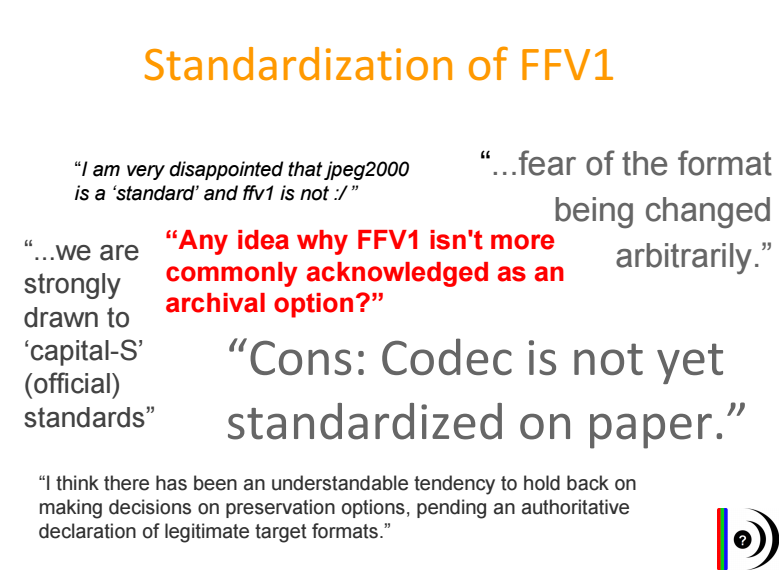
FIAT/IFTA World Conference, Vienna, October 2015, "FFV1 for Preservation" workshop
FFV1 standardization
Mainly sponsored by the PREFORMA project (2015-2017)
Review of the reference (FFmpeg) encoder and decoder
Review and improvement of the existing FFV1 spec draft
(written by Michael in LyX, on GitHub since 2012, converted to Markdown in 2015)
A conformance checker (MediaConch)
The IETF CELLAR working group, chartered in November 2015
FFV1 standardization
A slow process
Many people involved, little time
Most of the work done in people's spare time
Spec repository: 559 commits. Dave Rice ~290, Jérôme Martinez 140, Michael Niedermayer 95, Reto Kromer 13, Peter B. 11...
The IETF (the standards body) was very supportive
(thank you!)
FFV1 standardization
... but a very useful one!
Bugs found while reviewing the code
Corner cases clarified
e.g. slice tiling corner cases (ticket 5548): only fixed in version 4, in 2024
Derek Buitenhuis wrote an FFV1 decoder "for fun" (great: an independent look at the spec)
FFV1 standardization
FFV1 has been a standard since 2021 (IETF RFC 9043)
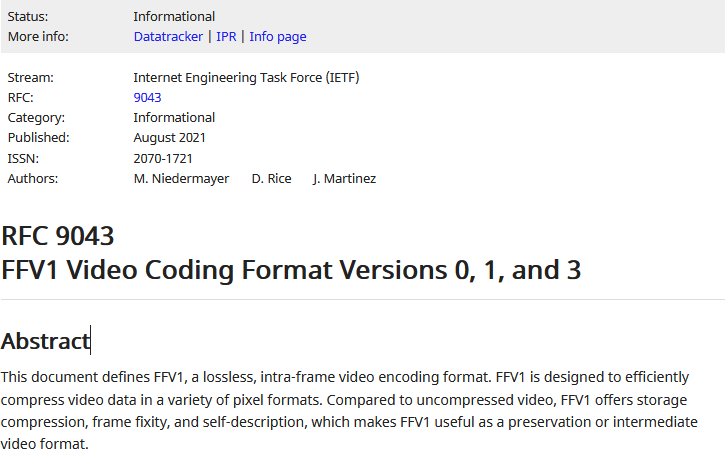
A big gap between the end of the main funding (2017) and the standard (August 2021)!
Reference encoder/decoder: more bit depths
For Y(A), YUV(A) and RGB(A)
- 2016: 12-bit YUV and gray, 16-bit RGB
- 2018: RGB48 no longer experimental, RGBA64, 10/12/16-bit RGBA
- 2023: 14-bit RGBA and gray, 12-bit YUVA
Adoption
Very early adopters: Österreichische Mediathek (in AVI), City of Vancouver Archives, CUNY TV
BFI National Archive: 3 PB of DPX scans to FFV1/MKV with RAWcooked (since 2019)
Many others: NYPL, Indiana University, Smithsonian Institution Archives, Irish Film Institute, WGBH...
December 2023: Library of Congress moves FFV1/Matroska from "Acceptable" to "Preferred"
FFV1 present: GPU support
Vulkan encoder and decoder by Lynne, in FFmpeg 8.0 (August 2025)
- Encoder (2024): versions 3 and 4, all pixel formats; real-time 1080p60 screen capture on modest GPUs
- Decoder (2025): 4K RGB screen recording at 400 fps on an RTX 6000 Ada, vs ~100 fps on a 24-thread Alder Lake CPU
- 2026: float and Bayer on the GPU too (FFmpeg 9.0, August 2026)
GPUs love many slices: up to 1024 slices now (32x32)
GPU: slow progress, then a big step
6464x4852 16-bit RGB film scan, RTX 5070 Ti (GPU) vs Core i7-13700K (CPU), MediaArea benchmarks
Many small steps for 14 months, then a rewrite of the range coder with GPU subgroups (September 2026, not in FFmpeg 9)
GPU: it paid off everywhere
6K 16-bit film scan, GPU vs CPU of the same computer
- RTX 3050 (entry level): GPU encoding was no faster than the CPU; now 3x faster
- Apple M4: GPU encoding was 45% slower than the CPU; now 15% faster
- RTX 3090: decoding 5.5x faster than the CPU
Next bottleneck: storage
Context models: which pixels?
| Differences used | Contexts | |
-context 0 | L−TL, TL−T, T−TR 11 levels (8-bit) or 9 levels | 666 / 365 |
-context 1 | same + LL−L, TT−T (5 levels each) | 7563 / 5063 |
-context 2 | L−TL, TL−T only 5 levels each | 13 |
The prediction is always the same: median of L, T and L+T−TL
The context only chooses which adaptive probabilities code the residual (32 bytes of state per context)
Many slices: a new problem
Every slice starts with fresh probability states
More slices = less data per slice to adapt
September 2026: a new, minimal context model (-context 2), not in FFmpeg 9
6464x4852 16-bit RGB film scan, 1024 slices, per frame:
-context 1: 100.79 MB-context 0: 90.29 MB-context 2: 87.99 MB (and 832 bytes of state per slice instead of 23 KB)
Stored in the extradata like the existing tables: existing decoders need no change
Not in FFmpeg 9: bug fixes too
Vulkan decoder fixes from August-September 2026:
- version 4.8+ RGB streams from the CPU encoder: garbled output
- pre-version 4 streams, non-keyframes: "intermittently decoded to garbage, with the slice CRCs still passing"
FFV1 near future: version 4
Already in FFmpeg 9.0 (August 2026), but still flagged experimental (-level 4 -strict experimental):
- Floating point: 16-bit and 32-bit
- Bayer (RGGB, 16-bit)
- Raw slices, per-slice color transform coefficients
Partly funded by the Sovereign Tech Fund (2024-2026)
Next steps: freeze the bitstream, finish the IETF specification
Version 4 current goals
| Bayer | ✓ in FFmpeg (RGGB 16-bit only), spec PR still open |
| Better compression / speed | ~ color transform search, -context 2, GPU |
| Limit worst-case size | ✓ raw slices |
| Arbitrary color spaces | ✗ multispectral PR, work in progress since 2019 |
| Floating point | ✓ in FFmpeg; spec: first text in 2025, update pending |
"Anything that finds no volunteers will be pushed to v5"
FFV1 further future
Not implemented yet:
- Other Bayer patterns and bit depths
- Raw storage of the lower bits
- More than 4 channels (multispectral, infrared)
- Inter prediction, other color transforms...
FFV1 in one slide
| 2003 | First commit in FFmpeg by Michael Niedermayer |
| 2006 | The 8-bit format (version 0) is declared stable |
| 2009 | Version 1: more than 8 bits per component (experimental until 2010) |
| 2010 | The Österreichische Mediathek and CUNY TV adopt it, then ask for features |
| 2012-2013 | Version 3: slices and CRCs. Stable in August 2013 |
| 2015-2017 | PREFORMA: spec review, conformance checker (MediaConch), IETF CELLAR |
| 2021 | RFC 9043 (versions 0, 1 and 3) |
| 2023 | Library of Congress: FFV1/Matroska becomes a "Preferred" format |
| 2025 | FFmpeg 8.0: GPU (Vulkan) support, version 3 becomes the default |
| 2026 | FFmpeg 9.0: version 4 with float and Bayer, still experimental. GPU speed x2 (after 9.0) |
It did not appear from nowhere
- One developer's hobby (2003)
- Archives paying for the features they need (2010-2013)
- An EU project paying for the spec and the checker (2015-2017)
- Volunteers finishing the standard (2017-2021)
- A public fund, the Sovereign Tech Fund, paying for some features (2024-2026)
- RAWcooked sponsors participating in GPU support (2025-2026)
Each step needed money and someone's time
"Allocate continuous resources (time or money)" (Peter B., NTTW3, 2018)
Stay in touch
MediaArea: https://mediaarea.net, @MediaArea_net
RAWcooked: https://MediaArea.net/RAWcooked
Jérôme Martinez: jerome@mediaarea.net
Slides: https://MediaArea.net/Events
License (except images): CC BY
Sources
- FFmpeg git history: code.ffmpeg.org/FFmpeg/FFmpeg (
git log -- libavcodec/ffv1*) - FFV1 specification repository: github.com/FFmpeg/FFV1, issues, PR #100 (Bayer), ffv1-v4-goals.md
- MediaArea FFV1 GPU benchmarks (FFV1_GPU_Report), April 2025 to October 2026
- FFmpeg pull requests:#22528 (Bayer), #24734 (Vulkan subgroups)
- IETF CELLAR interim meeting, 26 May 2026 (chat log)
- RFC 9043, draft-ietf-cellar-ffv1-v4, IETF CELLAR
- PACKED/Scart, interview with Peter Bubestinger and Herman Lewetz (Österreichische Mediathek), May 2014
- MediaArea blog, "MediaArea presents at FIAT/IFTA", October 2015
- P. Bubestinger-Steindl, "Open Source and Long Term", No Time To Wait 3, October 2018
- ffmpeg-devel, "FFV1 v3" thread, April 2012
- Library of Congress, "Embracing FFV1/Matroska", December 2023
- LinuxFr, "FFV1, un format vidéo sans perte et libre, normalisé à l'IETF", August 2021